
What Is an Email Drip Campaign?
An email drip campaign is a pre-written series of emails sent automatically over time after a user takes an action, reaches a status, or meets a rule inside your email platform or CRM. That action could be a signup, guide download, trial start, cart abandonment, demo request, purchase, or a period of inactivity.
This is the simplest way to define drip campaign activity. It is a planned follow-up that runs without a person sending every email by hand.
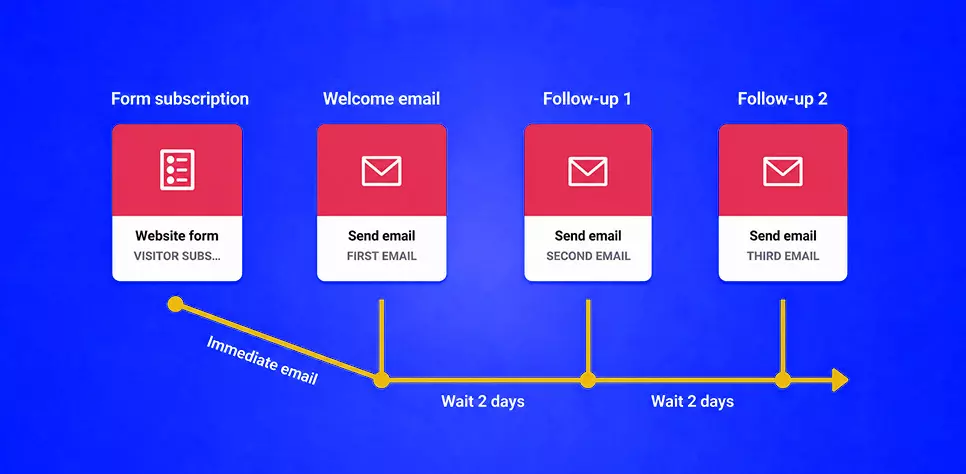
The main idea behind a drip email campaign is timing. Each email is sent at a planned moment, based on what the user did or where they are in the customer path. A new subscriber may receive a welcome email right away. A trial user may receive setup tips after one day. A lead who downloads a guide may receive helpful follow-up emails over the next few weeks.
Email Drip Campaign Definition
The best email drip campaign definition is simple:
An email drip campaign is an automated email sequence that sends pre-written messages over time based on user action, timing, or behavior.
This definition also explains what is a drip campaign in email marketing. It is a way to send the right follow-up at the right time without relying on manual work.
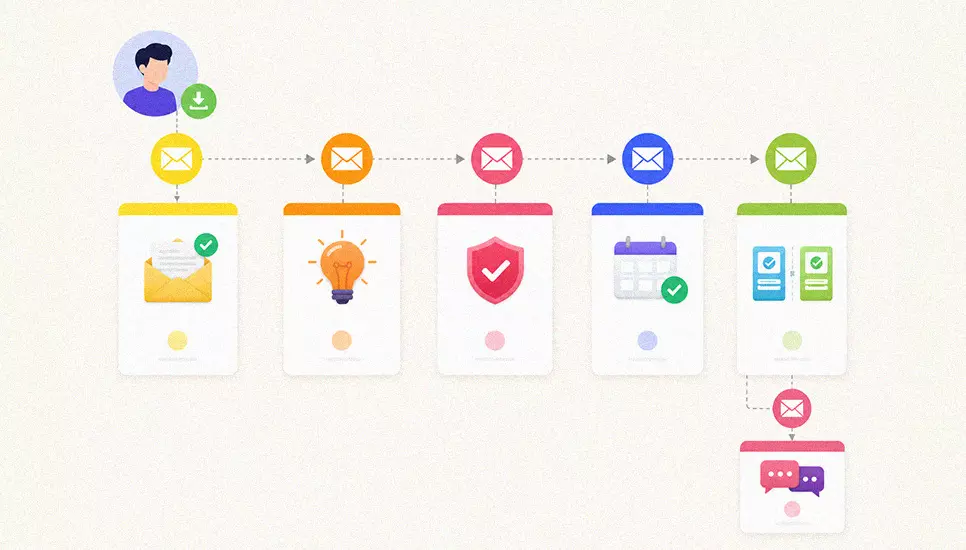
For example, someone downloads a pricing guide from your website. The first email sends the guide right away. A second email may explain the problem three days later. A third email may share proof after another few days. Later emails may invite the person to book a call, compare options, or ask a question.
Drip Campaign Terminology Cheat Sheet
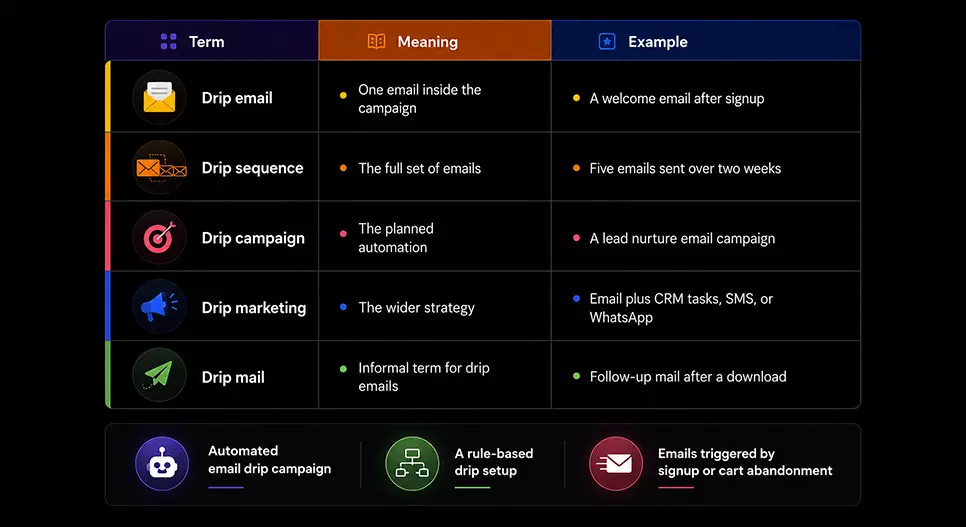
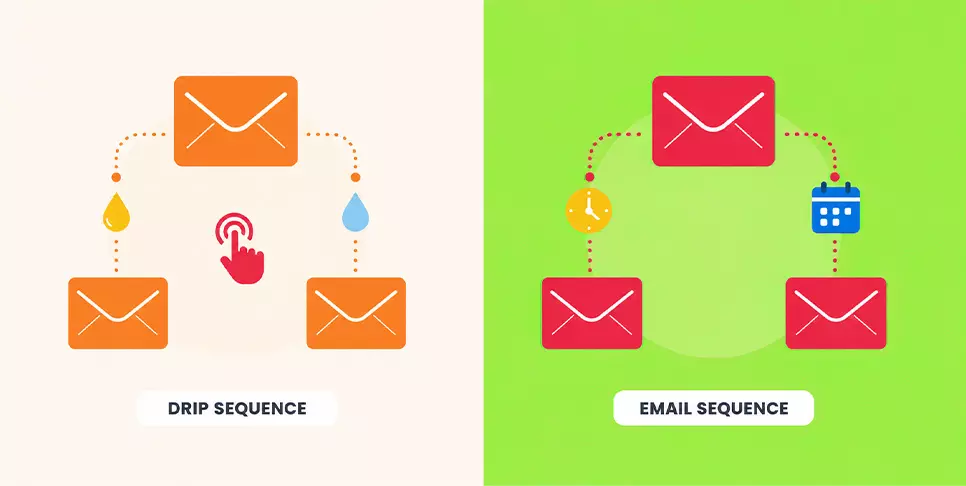
Many people use different terms for the same idea. Drip email, drip sequence, drip marketing, drip mail, and email drip all relate to automated follow-up emails. The difference is mostly in how each term is used.
| Term | Meaning | Example |
| Drip email | One email inside the campaign | A welcome email after signup |
| Drip sequence | The full set of emails | Five emails sent over two weeks |
| Drip campaign | The planned automation | A lead nurture email campaign |
| Drip marketing | The wider strategy | Email plus CRM tasks, SMS, or WhatsApp |
| Drip mail | Informal term for drip emails | Follow-up mail after a download |
| Automated email drip campaign | A rule-based drip setup | Emails triggered by signup or cart abandonment |
How an Email Drip Campaign Works
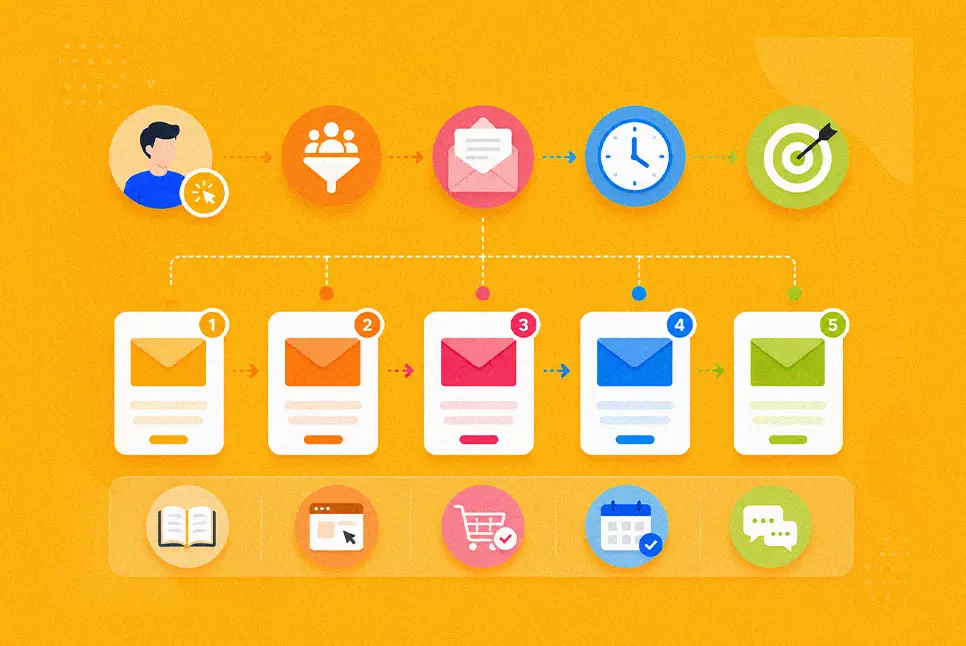
An email drip campaign works through a simple automation path. A user takes an action. The system reads that action. Then it sends the right email based on the rule you set. A good drip email campaign is not random. It has a trigger, a segment, a sequence, timing, and an exit rule. These five parts decide who receives the emails, what they receive, when they receive it, and when the campaign should stop. For most marketing drip campaigns, the goal is to move the contact one step forward. That step may be reading a guide, finishing account setup, returning to a cart, booking a call, or replying to a sales email.
What Triggers a Drip Campaign
A trigger is the action or condition that starts the drip campaign.
This could be a form submission, a newsletter signup, a product trial, a quote request, a purchase, cart abandonment, or inactivity. The trigger gives the campaign context. It tells the system why this person should receive the next email.
For example, someone who downloads a beginner guide may need education. Someone who clicks a pricing page may need proof. Someone who abandons a cart may need a reminder. These contacts should not receive the same drip sequence.
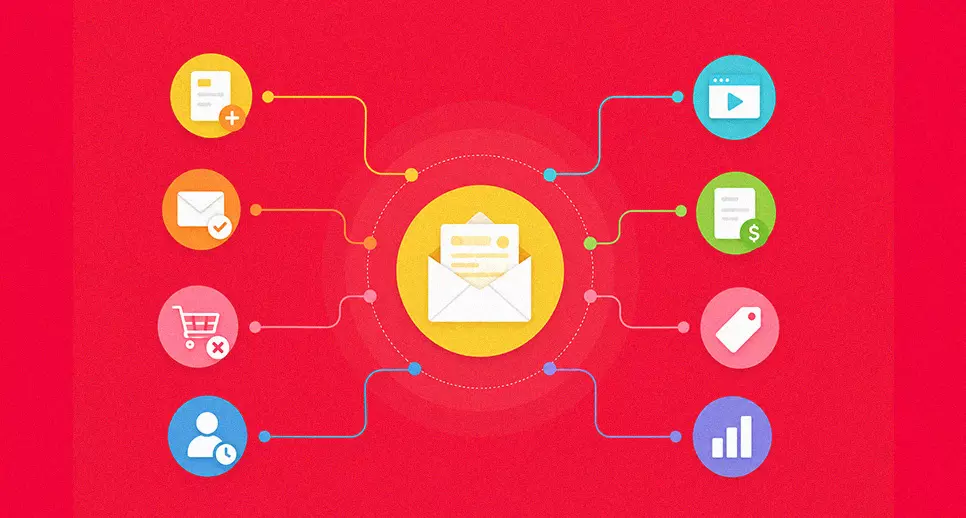
Common drip campaign triggers include:
| Trigger | What It Means | Example Drip Email |
| Signup | A user joins your list | Welcome email |
| Guide download | A lead shows interest | Resource delivery and follow-up |
| Demo request | A lead has buying intent | Confirmation and sales prep |
| Cart abandonment | A shopper leaves checkout | Cart reminder |
| Trial start | A user begins using a product | Onboarding email |
| Inactivity | A contact stops engaging | Re-engagement email |
How Segmentation Decides Who Receives Each Email
Segmentation decides which contacts should enter a specific email drip campaign.
This matters because not every subscriber has the same need. A new lead, old customer, trial user, and inactive contact are at different points. They need different messages.
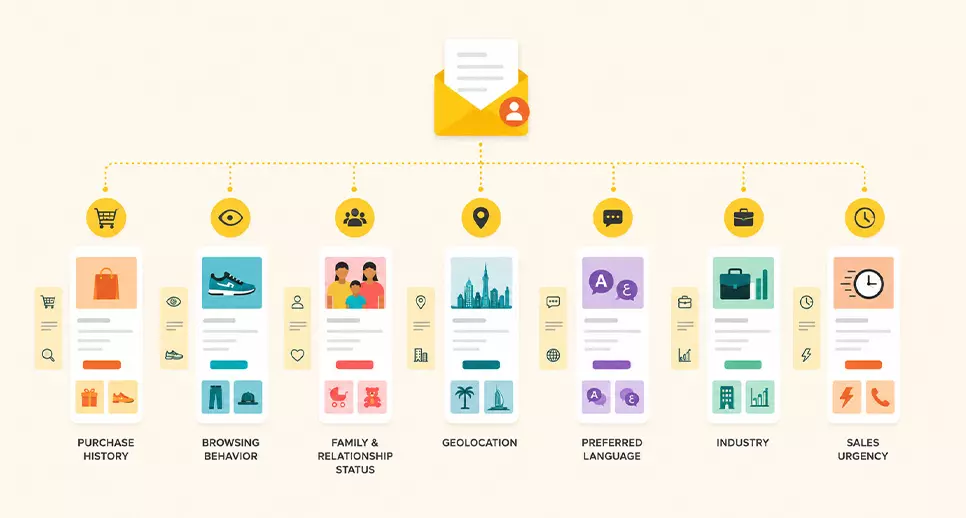
You can segment contacts by behavior, interest, source, location, language, lead stage, purchase history, or service need. For Dubai businesses, segmentation may also include English or Arabic preference, industry, area, or sales urgency.
For example, a real estate lead looking at villas should not receive the same drip emails as a lead looking for commercial office space. A B2B lead who requested a proposal should not receive the same welcome series as a casual newsletter subscriber.
How the Email Sequence Is Structured
The sequence is the order of emails inside the drip campaign. Each email should have one job. Do not make every email sell. Some emails should educate. Some should answer doubts. Some should share proof. Some should ask for the next step. A simple lead nurture drip sequence can look like this:
| Main Job | Example CTA | |
| Email 1 | Deliver the resource | Read the guide |
| Email 2 | Explain the problem | See the checklist |
| Email 3 | Show the solution path | View the process |
| Email 4 | Share proof | See the example |
| Email 5 | Handle a common doubt | Compare options |
| Email 6 | Invite action | Book a call |
For a Dubai real estate client, we mapped the sequence before writing a single email, and that one change alone cut the sequence from 9 emails to 5. Reply rate on the flow went from roughly 4% to 9% over the following quarter.
When a Contact Should Exit the Campaign
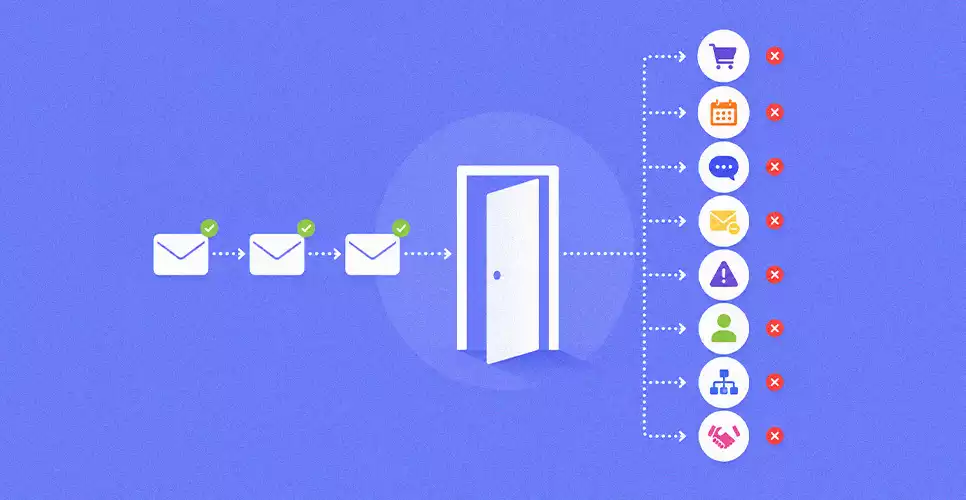
An exit rule decides when a contact should stop receiving the drip sequence.
This is one of the most important parts of a drip campaign strategy. Without exit rules, people may keep receiving emails that no longer match their situation.
A contact should usually exit when they:
- Buy the product
- Book a call
- Reply to sales
- Unsubscribe
- Bounce repeatedly
- Become inactive
- Move into another campaign
- Enter an active sales opportunity
Why Email Drip Campaigns Matter

An email drip campaign matters because most people do not act after one touch. They may download a guide, visit a service page, start a trial, or abandon a cart, then leave without taking the next step. A drip campaign keeps the follow-up consistent without asking your team to send every email manually.
It also helps nurture leads over time. Instead of pushing for a sale too early, a drip email campaign can educate, answer doubts, share proof, and guide the reader to one clear action.
For customers, drip emails can support onboarding, repeat purchases, appointment prep, product education, and re-engagement. This makes the campaign useful beyond lead generation.
Email Newsletter vs Drip Campaign vs Nurture Campaign
An email newsletter, drip campaign, and nurture campaign all use email, but they do different jobs. A newsletter is usually sent to a broad list at the same time. It is best for updates, announcements, new content, offers, and company news. The business decides when to send it.
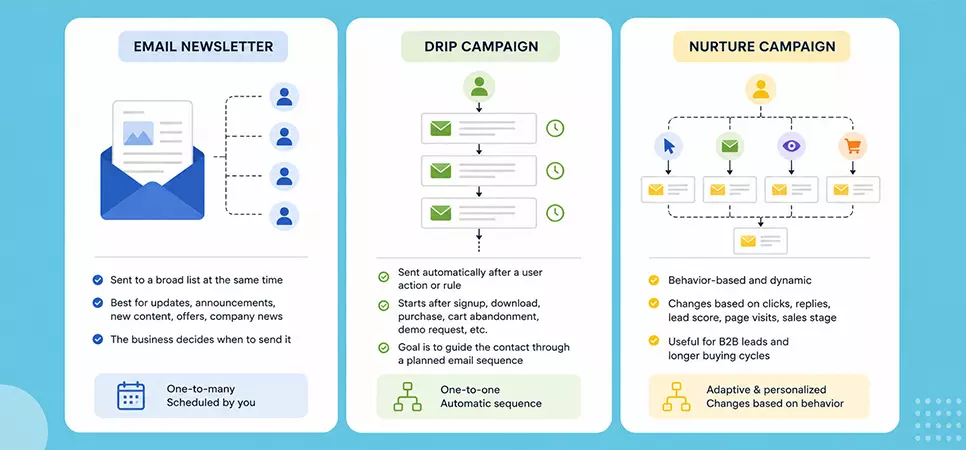
An email drip campaign is sent automatically after a user action or rule. It may start after a signup, download, purchase, cart abandonment, or demo request. The goal is to guide the contact through a planned email sequence.
A nurture campaign is often more behavior-based. It can change based on clicks, replies, lead score, page visits, or sales stage. This makes it useful for B2B leads and longer buying cycles.
| Type | How It Works | Best Use |
| Newsletter | Sent to a list at the same time | Updates, news, offers |
| Drip campaign | Sent after a trigger or timing rule | Welcome, onboarding, cart recovery |
| Nurture campaign | Changes based on behavior or lead stage | B2B sales and longer decisions |
Use a newsletter when you want to keep your audience informed. Use a drip email campaign when someone takes a clear action and needs structured follow-up. Use a nurture campaign when the lead needs different messages based on interest, intent, or sales activity.
Common Types of Marketing Drip Campaigns
Marketing drip campaigns can support different parts of the customer path. The right type depends on what the user just did and what they need next.
Welcome Email Drip Campaign
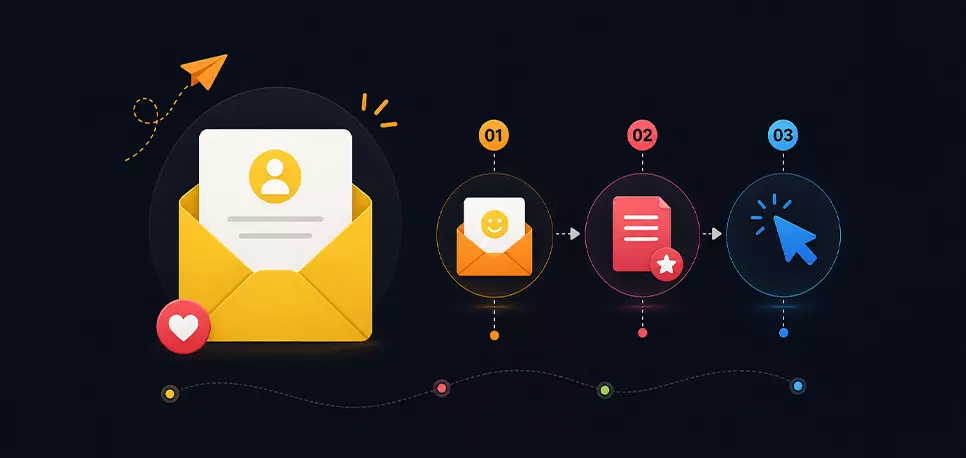
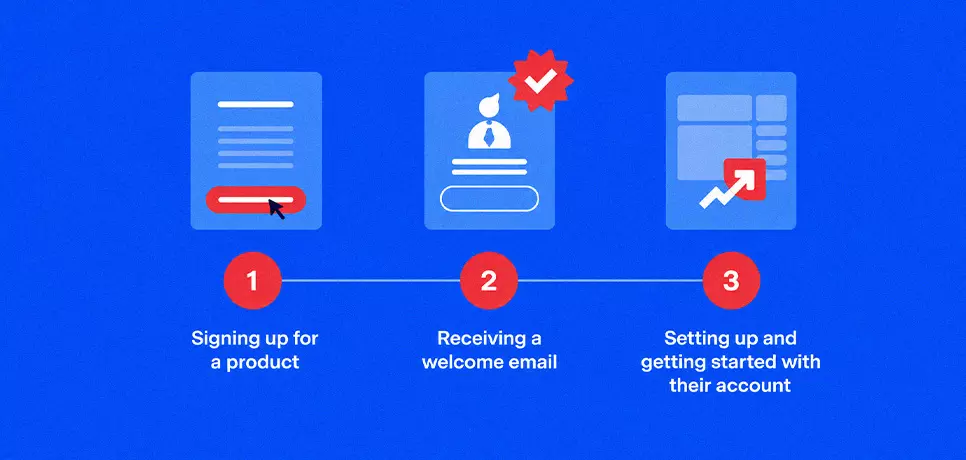
A welcome email drip campaign starts after someone joins your list, creates an account, or submits a form. It confirms the signup, sets expectations, and gives the reader a useful first step.
This sequence should be simple. The first email can welcome the subscriber. The next can share your best resource, explain how you help, or guide them to a low-friction action.
Lead Nurture Drip Campaign
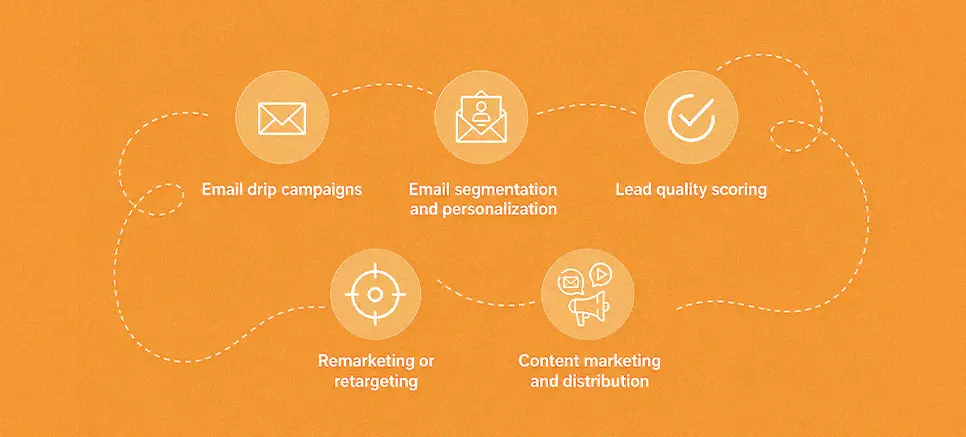
A lead nurture drip campaign is used when someone shows interest but is not ready to buy. This is common in B2B, real estate, SaaS, agencies, clinics, and service businesses.
The sequence can explain the problem, share proof, answer doubts, and move the lead closer to a call, quote, demo, or purchase. The goal is to build trust before asking for a stronger action.
SaaS or Customer Onboarding Drip Campaign
A SaaS or customer onboarding drip helps new users or customers get value faster. It can show them how to set up an account, use a feature, prepare for a service, or avoid common mistakes.
For SaaS, this may include setup tips, feature prompts, and trial reminders. For service businesses, it may include appointment prep, project steps, or what to expect next.
Abandoned Cart Drip Campaign
An abandoned cart drip campaign is common in ecommerce. It starts when someone adds items to a cart but leaves before buying.
The first email usually reminds the shopper. Later emails can answer buying doubts, show product benefits, add social proof, or offer an incentive if needed.
Post-Purchase Email Drip Campaign
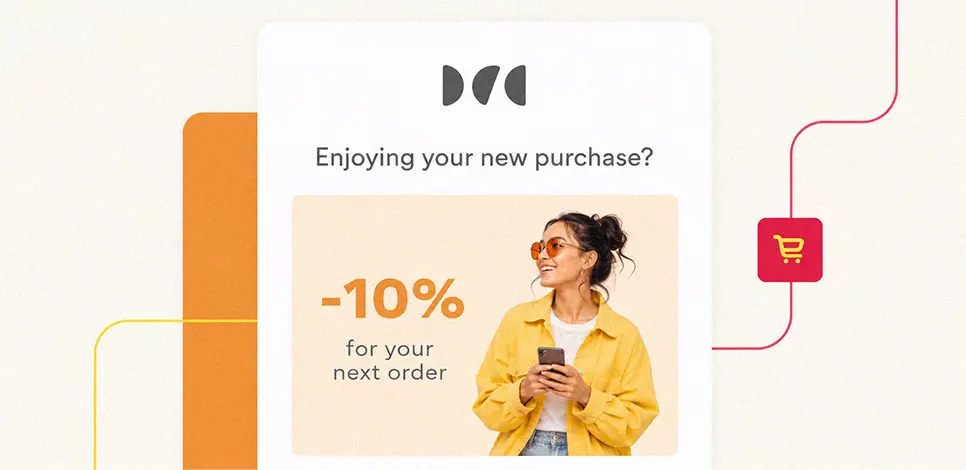
A post-purchase email drip campaign starts after a sale. It helps the customer use what they bought and keeps the relationship active.
This sequence can include order details, product tips, care instructions, review requests, referral prompts, or related products.
Drip Campaign Strategy: A 7-Step Framework
A strong drip campaign strategy starts before you write the emails. The goal is to connect the right audience, trigger, message, timing, and next step into one clear flow.
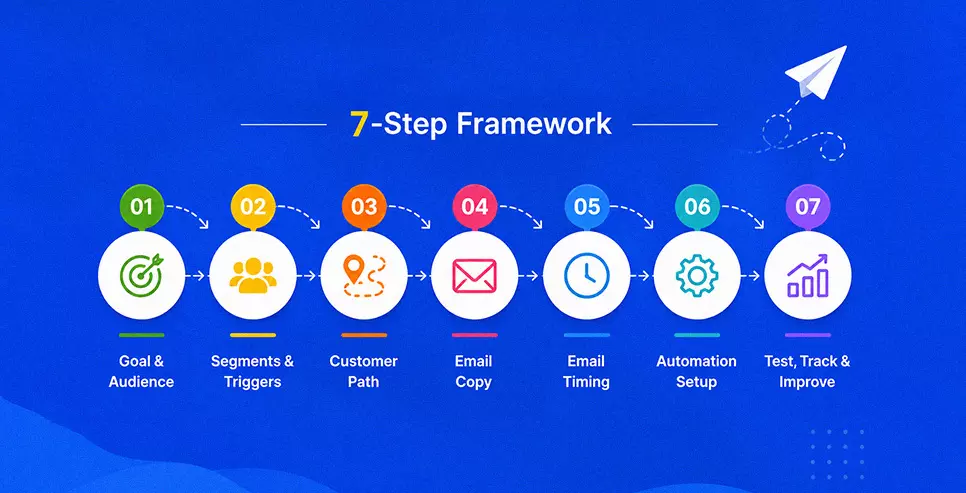
- Goal and audience: Start with one goal and one audience. A drip campaign for a new subscriber will look different from a drip campaign for a demo lead, cart abandoner, trial user, or inactive customer.
- Segments and triggers: Segments decide who enters the campaign. Triggers decide when they enter. A trigger could be a form fill, guide download, cart abandonment, quote request, trial signup, purchase, or inactivity period.
- Customer path: Map what the user needs before they take the next step. Some users need education. Some need proof. Some need pricing clarity. Some need a reminder.
- Email copy: Write each drip email with expert copywriting and one job. One email may deliver a resource. One may explain the problem. One may show the solution path. One may share proof. One may answer a common doubt.
- Email timing: Timing should match user intent. For a standard email nurture drip sequence, a good starting point is 3-4 days apart, then weekly. Abandoned cart emails can move faster.
- Automation setup: Build the workflow in your email tool or CRM. This could be Mailchimp, SendGrid, HubSpot, ActiveCampaign, Klaviyo, or another email marketing automation platform.
- Testing before launch: Test the full campaign before it goes live. Check subject lines, links, personalization fields, mobile layout, sender name, unsubscribe link, and tracking.
Track clicks, replies, bookings, purchases, trial activation, unsubscribe rate, spam complaints, and revenue per subscriber. If users click but do not convert, review the CTA or landing page.
Sample Drip Campaign: 7-Email B2B Sequence
A B2B email drip campaign should help a lead move from interest to action without feeling rushed. This sample drip campaign is built for a service business where a lead downloads a guide, checklist, or pricing resource.
The trigger is simple: the lead submits a form and receives the first email immediately. The goal is to turn that interest into a qualified sales conversation.
| Timing | Main Job | Example Subject | |
| 1 | Immediately | Deliver the resource | Your guide is here |
| 2 | 3 days later | Explain the problem | Where manual follow-up breaks |
| 3 | 3-4 days later | Show the solution path | A simple follow-up system |
| 4 | 4 days later | Share proof | What this looks like in practice |
| 5 | 1 week later | Handle doubt | What if your CRM is messy? |
| 6 | 1 week later | Compare options | Drip vs manual follow-up |
| 7 | 1 week later | Ask for action | Want help mapping this? |
This 7-email drip sequence works because each email has one role. The first email delivers what the lead asked for. The next few emails build context and trust. Later emails handle objections and invite the next step.
Choosing the Best Email Drip Campaign Software
The best email drip campaign software depends on your team, data, and campaign goal. A small business may need a simple visual builder. A SaaS company may need API-based triggers. A sales team may need CRM alerts, lead scoring, and deal-stage automation.
Mailchimp is often a good fit for simple email marketing drip campaigns. It works well for welcome flows, basic lead nurturing, newsletters, small business campaigns, and ecommerce follow-up. If your team wants an easier visual setup, Mailchimp drip campaign features may be enough. As of 2026, Mailchimp’s paid plans start around $13/month for the Essentials tier and $20/month for Standard, both at 500 contacts, with costs rising as your list grows.
SendGrid is often a better fit for product-led or developer-led email systems. A SendGrid drip campaign can work well when emails need to be triggered by app events, API calls, account activity, or transactional actions. SendGrid’s Email API pricing starts around $19.95/month for 50,000 emails, while its separate Marketing Campaigns product starts around $15/month for up to 1,000 contacts, so teams needing both usually end up paying for two plans.
| Need | Mailchimp | SendGrid |
| Simple welcome flow | Strong fit | Possible |
| Marketer-friendly setup | Strong fit | Needs more setup |
| API-triggered emails | Possible | Strong fit |
| Transactional email | Limited by use case | Strong fit |
| Custom product events | Possible with setup | Strong fit |
| Ecommerce follow-up | Strong with integrations | Possible with setup |
In our work at COLAB DXB, we usually choose the tool after mapping the workflow. The wrong order creates problems. If you choose software first, you may build the campaign around tool limits instead of customer behavior.
Drip Campaign Mistakes to Avoid in 2026
The best email drip campaign best practices are simple. Send relevant emails, use clean data, respect consent, and measure actions that matter.
- Do not send the same drip sequence to every contact. A lead who downloads a beginner guide needs a different path from someone who visits a pricing page, abandons a cart, or requests a quote.
- Each drip email should ask for one clear action. That action could be to read the guide, finish setup, view a case study, return to cart, reply with a question, or book a call.
- Match the email to the buyer stage. Early emails can educate. Middle emails can build trust and answer doubts. Later emails can invite a stronger action.
- Use behavior-based personalization. First-name personalization is basic. A stronger drip email campaign uses signals such as pages visited, products viewed, links clicked, lead source, service interest, or lifecycle stage.
- Set a healthy email frequency. For a standard email nurture drip sequence, start with emails 3-4 days apart, then move to weekly. Faster timing can work for abandoned cart emails or event reminders. Slower timing may work better for B2B sales.
- Use suppression and exit rules. If someone buys, books a call, replies, unsubscribes, bounces, or becomes an active sales opportunity, they should leave the current email drip campaign.
Measuring and Optimizing Drip Campaign Performance
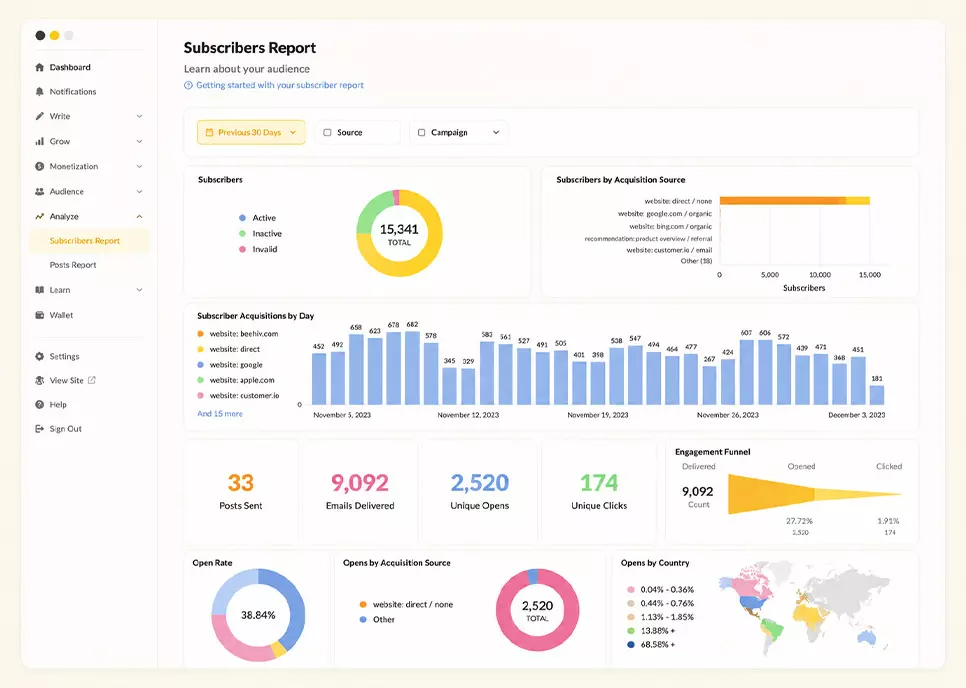
Measuring a drip campaign means looking beyond open rates. Opens can show interest, but they do not prove that the campaign is creating leads, bookings, purchases, or revenue. A stronger view looks at what people do after they receive the email.
Track clicks, replies, form submissions, booked calls, purchases, trial activation, unsubscribe rate, bounce rate, spam complaints, and revenue per subscriber. These numbers show whether the email drip campaign is moving people closer to the right action. As a rough benchmark, most industries see click-through rates in the 2-3% range and unsubscribe rates under 1%, though automated drip and flow emails typically convert several times higher than one-off newsletter blasts, since they reach someone at a more relevant moment.
| Metric | What It Shows |
| Click rate | Whether the message and CTA are relevant |
| Reply rate | Whether the email starts real conversations |
| Conversion rate | Whether users take the intended action |
| Unsubscribe rate | Whether timing or message fit is weak |
| Spam complaints | Whether the campaign is hurting trust |
| Revenue per subscriber | Whether the drip sequence supports business results |
A/B testing can help in conversion rate optimization. Test one variable at a time, such as subject line, CTA, email length, send delay, offer angle, or proof point. If you test too many things at once, it becomes hard to know what caused the result.
Drip Campaign Flowchart
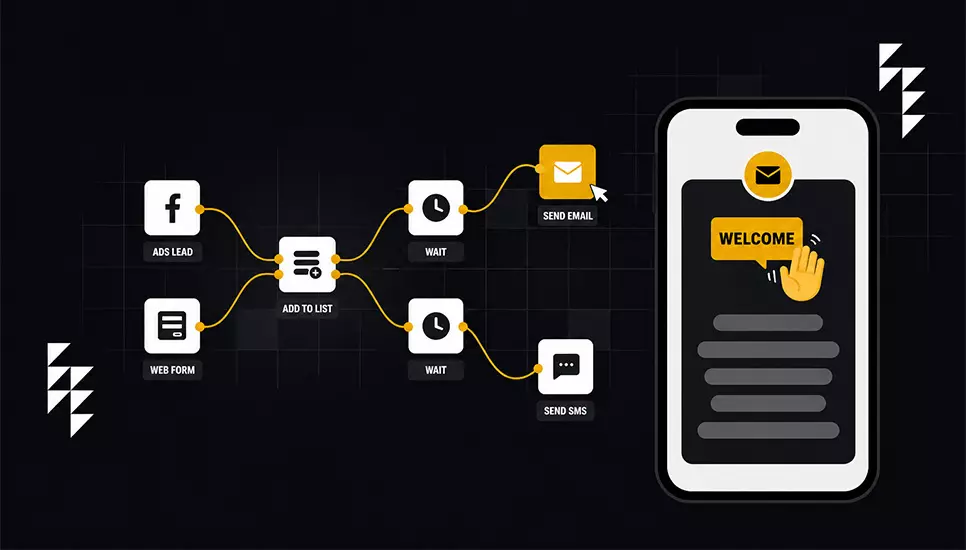
A drip campaign flowchart helps you see the full automation path before the emails go live. It shows how a contact enters the campaign, what email they receive first, how the system checks their behavior, and when they should exit, branch, or move to another flow.
Simple Email Drip Campaign Flow
Here is a simple email drip campaign flow:
| Step | What Happens |
| 1 | User takes an action |
| 2 | Campaign trigger starts |
| 3 | System checks segment and consent |
| 4 | Email 1 is sent |
| 5 | User acts or ignores |
| 6 | If user acts, exit or notify sales |
| 7 | If user ignores, wait 3-4 days |
| 8 | Email 2 is sent |
| 9 | System checks behavior again |
| 10 | Continue, branch, suppress, or move to weekly nurture |
Behavior-Based Drip Campaign Flow
A behavior-based drip campaign flow changes based on what the user does. If a lead clicks a pricing page, they may receive a proof email or sales follow-up. If they ignore several emails, they may move to a slower re-engagement sequence. If they book a call, they should leave the current drip sequence.
Email Drip Campaign Data Structure
An email drip campaign data structure defines the information your email tool or CRM needs to send the right message at the right time.
At minimum, the system should track contact details, consent status, trigger type, campaign ID, email step, send delay, CTA, engagement, and exit rules.
This is different from knowing why a campaign starts. The data structure below shows what the CRM or email platform needs to store once it has started, so it can act correctly at every later step.
Useful data fields include email address, company, location, language preference, consent source, lifecycle stage, clicks, replies, conversions, unsubscribes, bounces, and suppression reason.
Dubai and UAE Notes for Email Drip Campaigns

Dubai and UAE email drip campaigns need clear consent, accurate sender identity, and careful channel use. The UAE’s Personal Data Protection Law is the federal framework for personal data privacy and data management, so businesses should treat email addresses, names, phone numbers, and lead details as data that must be handled with care.
For marketing messages, consent should be easy to understand and record. TDRA’s unsolicited electronic communications policy says consent records should include details such as date, time, the wording used to capture consent, customer identity, and IP address when consent is collected online.
For Dubai campaigns, language also matters. English may work well for many B2B, real estate, SaaS, ecommerce, and agency audiences. Arabic may be better for local trust, GCC buyers, finance, healthcare, luxury, and government-linked sectors. Do not just translate the same drip email campaign. Adjust the proof, offer, tone, and CTA with multilingual services.
How COLAB DXB Helps Dubai Businesses Build Email Drip Campaigns
COLAB DXB helps Dubai businesses turn email drip campaigns into connected lead-nurture systems. The goal is not to send more emails. The goal is to connect the landing page, lead form, CRM, email sequence, sales handoff, and reporting into one clear flow.
A real estate business may need area guides, viewing reminders, and buyer follow-up. A clinic may need service education, appointment reminders, and trust-building emails. A B2B company may need proof, comparison content, and a clear call-booking step.
At COLAB DXB, the process starts with the trigger. This could be a form fill, quote request, guide download, demo request, or abandoned checkout. From there, the audience is segmented by intent, service interest, language, and location.
The drip sequence is then written with one job per email. Timing rules and exit rules are added so buyers, booked leads, unsubscribed users, and active sales opportunities stop receiving the wrong message.


About The Author
Sid hasan
Sid Hasan is an entrepreneur and marketing strategist recognized for his expertise in brand growth, digital innovation, and business development. With over a decade of experience, he has guided companies in building data-driven marketing ecosystems that generate measurable results.
As the founder of COLAB Marketing Inc., Sid leads a global agency serving over 200 brands across the U.S. and UAE, blending creative storytelling with performance-driven strategy to help businesses scale effectively.
Through COLAB, he continues to empower emerging and established brands to transform ideas into lasting market impact through strategic clarity, creative execution, and digital excellence.
